Artificial Intelligence has become a game-changer in the industries over the past decade, with the potential to analyze large amounts of data and automate processes and improve the process of decision-making.
Among the logistics industry is experiencing one of the most radical transformations, AI adoption in logistics is emerging as a critical competitive advantage. As the improvement of efficiency and customer expectations, as well as global supply chains have become complicated, rising fuel costs, and with the need to deliver faster, logistics companies are increasingly turning to AI to stay competitive. Logistics companies are increasingly leveraging AI to improve efficiency, reduce costs, and maintain operational agility.
Artificial intelligence is transforming the movement of goods, the storage and delivery of goods and services with AIs optimizing delivery routes, warehouse management to predict demand forecasting and improve more personalized customer service. According to industry estimates, AI based logistics can assist organizations to save operational costs, cut down on delivery times and increase customer satisfaction to significant degrees in a mass setting.
As one of the leading logistics software development companies, Bluetris offers insights into how AI may be used to make its operations smarter. Here, you will have real-life examples, applications, and answers to the most significant questions about AI-powered logistics.
In this blog, we explore how AI is transforming logistics operations, the core technologies behind it, and the measurable benefits businesses can achieve by adopting AI-powered logistics solutions.
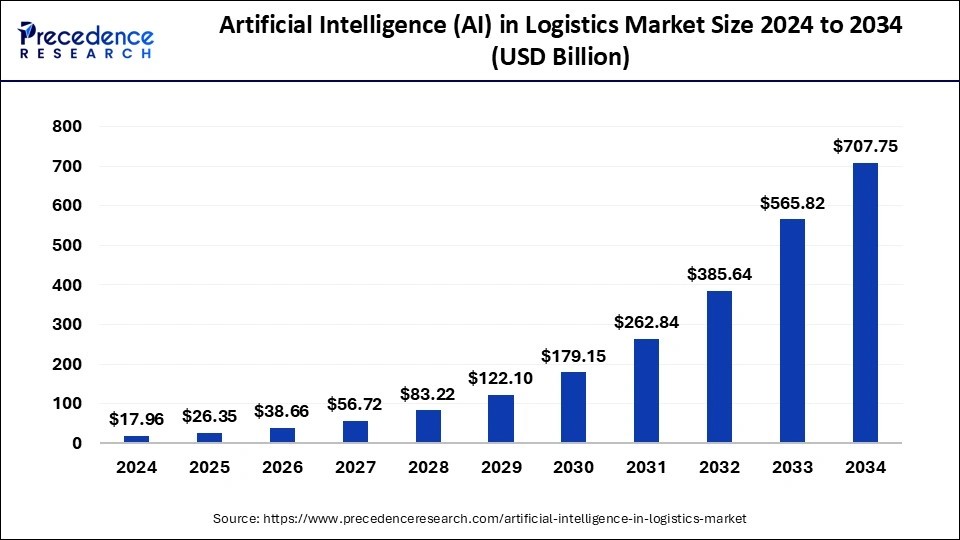
The global logistics industry is estimated to be about 11.41 trillion dollars. To be more precise, we can speak of AI in supply chain management and logistics. According to Precedence Research Report, the global artificial intelligence (AI) in the logistics market size was estimated at USD 17.96 billion in 2024 and which is projected to grow between USD 26.35 billion in 2025 to USD 707.75 billion in 2034 with a CAGR of 44.40% in 2025 and 2034. The artificial intelligence (AI) of the logistics market is being influenced by the emerging trends in the logistics industries in the globe.
What is AI in Logistics?
The essence of AI in logistics is to utilize high-level algorithms and machine learning in order to streamline various aspects of the supply chain.
It involves the automation of repeated processes and the enhancement of procedures with the help of data-driven insights that previously were rather hard or rather impossible to attain. The technologies can assist the companies to make more intelligent decisions, enhance efficiency, and minimize operational errors.
AI in logistics is all about solving complicated problems and unlocking new opportunities. The large number of moving components and network in logistics makes AI critical in predicting the needs of production, anticipating the volume in transportation, and the allocation of resources throughout the supply chain.
By leveraging AI, logistics firms can optimize work, reduce expenses and have a competitive advantage in an ever-growing and rapidly developing market. With AI-driven logistics, predictive analytics logistics and other such solutions, companies are developing smarter and more adaptable supply chains that enable them to satisfy the needs of contemporary commerce.
How AI is Transforming the Logistics Industry
The logistics industry has always faced complex challenges, it has been struggling to control large networks of transport, and to anticipate the demand in a highly dynamic market. Historically, the sector was concerned with transportation, warehousing, and distribution; nevertheless, the sector is rapidly advancing, as the global supply chains are getting more complex.
Among the latest technological advancements, AI in logistics has emerged as a true game-changer. AI is enabling companies to be smarter, faster, and more efficient with the capability to process large volumes of data in real time.
Smarter Route Optimization
AI-based logistics systems help companies to determine the most effective delivery routes based on traffic patterns, weather patterns, and delivery schedules. This not only saves on transportation expenses, but it also enhances speed and reliability of delivery, which is of benefit to businesses as well as customers.
Advanced Warehouse Management
AI is changing the work of the warehouse. Automated systems enhance better management of inventory, the picking and packing process is simplified and in addition, damaged goods are detected. AI helps to optimize the layout of any warehouse, process orders faster, and reduce errors, so operations become more efficient by analyzing sensor data.
Accurate Demand Forecasting
With AI, it is easier to predict future demand. Through analysis of existing trends and historical data, AI-driven systems can deliver insights that can help logistics companies keep the most optimal levels of inventory in place, improve the process of fulfillment and address the needs of customers in a more efficient manner.
Enhanced Customer Service
Customer satisfaction is crucial in logistics. AI-powered chatbots provide 24-hour support to customers, assisting them in shipping tracks, taking returns, and resolving an inquiry. This enhances reaction time and builds on trust and loyalty.
Predictive Maintenance
AI helps companies avoid expensive downtimes of equipment. By utilizing AI to analyze data collected by vehicles and machine predictions, it is possible to prevent pre-eminent failures and eliminate downtimes, enhance safety standards, and ensure the seamless flow of operations.
The Role of AI in Logistics
AI has become a transformative technology in all industries, and logistics is not an exception. AI and machine learning are assisting companies to utilize supply chains in an optimal way by automating manual operations, processing large quantities of data, and making smarter decisions, which can optimize the performance of businesses. The following is the way AI is becoming essential in logistics and shipping:
Supplier Management
Natural Language Processing (NLP) allows the logistics companies to process and read the conversations with suppliers, derive meaningful insights, and track interactions. This assists in detecting any trouble beforehand, building stronger relationships with suppliers, and having a smoother procurement process.
Demand Forecasting
AI analyzes determine previous demand and present market trends to forecast demand in the future. This helps firms to maximize inventory, production planning and develop effective distribution strategies that will satisfy customer expectations at all times.
Risk Management
Logistics operations face many risks, from delivery delays to equipment failures. AI help companies in modeling various risk scenarios, prescribing preventive actions and developing a contingency action plan in order to reduce costs.
Logistics Network Design
The optimization of logistics networks leads to cost reduction, elevation of the level of services, and the shortening of the delivery time. AI takes into account such aspects as storage points, movement connections, and demand trends to create effective and affordable networks.
Fraud Detection
AI identifies unusual patterns that may indicate fraudulent activities such as shipment fraud, returns fraud, or procurement issues. In comparison with conventional approaches, AI-driven detection is more accurate, faster and less likely to lead to losses.
Key Benefits of AI in Logistics
The AI is quickly changing the logistics and supply chain business with quantifiable results in terms of operations. According to a McKinsey report, businesses leveraging AI achieved 15% cost reduction, 65% improvement in service levels, and a 35% decrease in inventory levels. These statistics indicate the actual effect AI may have on efficiency, cost reduction, and customer satisfaction.
The following are the major advantages of AI in logistics:
Improved Operational Efficiency
AI is used to automate routine processes related to inventory management, order management, and reporting. The logistics processes are accelerated, more regular, and less error-prone by reducing manual intervention.
Reduced Operational Costs
Optimization of routes, predictive maintenance, and effective warehouse management significantly reduce fuel consumption, labor costs, and equipment downtimes. AI helps the logistics companies to become leaner and more cost-effective operations.
Increased Demand Accuracy
Accurate demand forecasting is important in logistics. The AI systems use past and present data to identify the possible problems during the delivery process and provide priority to the shipment to be completed sooner to facilitate the smooth workflow and customer satisfaction.
Enhanced Demand Accuracy and Inventory Control
Accurate forecasting reduces excess inventory and shortages. This results in an improvement of the cash flow and improved the service levels throughout the supply chain.
Improved Customer Satisfaction
Real-time tracking, proactive communication, as well as faster issue resolution improve the overall customer experience. The AI allows logistics companies to deliver beyond the expectations of the customers at all times.
How Bluetris Supports AI-Driven Logistics Transformation
Bluetris Technologies and AI in Logistics
Bluetris Technologies assists logistics companies in designing and deploying AI-powered solutions based on the requirements of their businesses. Bluetris has a deep understanding in AI, data engineering, and logistics software development and helps organizations transform their modernize supply chains and unlock new efficiencies.
Intelligent route optimization and predictive analytics to warehouse automation and AI-powered customer engagement tools are a few of the many AI solutions offered by Bluetris to solve a problem in a scalable, cost-effective, and measurable way. The approach emphasizes on the real business results like cost savings, speedy deliveries, and decision-making.
Organizing the strategy of AI with logistics objectives, Bluetris helps businesses transition from traditional logistics operations to intelligent, future-proof intelligent logistics supply chain.
Conclusion
Artificial intelligence is no longer a new emerging trend in logistics; it has become a very serious source of competitive advantage and operational excellence. AI is radically changing the logistics processes by allowing smarter routing, intelligent warehouses, accurate demand forecasts, predictive maintenance, and increasing customer interactions.
Companies implementing AI-powered logistic systems are able to have more visibility, efficiency and resiliency in their supply chains. Since global logistic networks will be getting more complex, AI will gain a greater focus in maintaining speed, precision, and reliability.
Frequently Asked Questions (FAQs)
What is AI in logistics?
AI in logistics refers to the use of artificial intelligence technologies such as machine learning, predictive analytics, and automation to optimize supply chain operations. It enables logistics companies to improve routing, warehouse management, demand forecasting, and decision-making using real-time data.
How is AI transforming logistics operations?
AI is transforming logistics operations by enabling smarter route optimization, automated warehouse workflows, accurate demand forecasting, and predictive maintenance. With AI-powered logistics solutions designed by Bluetris Technologies, businesses can achieve faster deliveries, reduced costs, and better supply chain visibility.
What are the key benefits of AI in logistics?
The key benefits of AI in logistics include improved operational efficiency, reduced transportation and inventory costs, enhanced demand accuracy, and improved customer satisfaction. Bluetris helps logistics companies realize these benefits by building scalable, data-driven AI solutions aligned with real business goals.
How does Bluetris help companies adopt AI in logistics?
Bluetris supports logistics companies by designing and implementing AI-driven solutions such as intelligent route optimization, predictive analytics, warehouse automation, and AI-powered customer engagement tools. By aligning AI strategy with logistics objectives, Bluetris enables businesses to transition from traditional operations to smart, future-ready supply chains.